
Garner Institution Release Meaning
Garner Correctional Institution is a level 4 Connecticut Department of Correction facility in Newtown. CT DOC says it incarcerates both pretrial and sentenced offenders and provides mental health treatment for people assigned from throughout the system. That statewide mission explains why a Norwalk case may lead to Garner even though Bridgeport Correctional Center is the facility directly tied to Norwalk court commitments.
Release from Garner must be defined by the destination. A person may return to the community after a court order or sentence event. Another may enter parole, special parole, a halfway house, or a state-approved program. Someone else may move to another institution while remaining confined. A transfer out of Garner is not a state release record, even when Garner no longer appears as current location.
| Recorded movement | What it means | Where to verify |
|---|---|---|
| Community release | Physical confinement ends | DOC status, CT SAVIN, court |
| Parole or special parole | Community supervision begins or continues | DOC and BOPP records |
| Community program | Approved placement with DOC control | DOC status and supervising contact |
| Institution transfer | Custody continues at a new location | DOC current location |
Check Garner Institution Release
The CT DOC Inmate Information Search covers Garner because it is a state correctional institution. Search by inmate number when possible. If the number is not known, use the name and confirm the match with date of birth, court identifiers, or the Norwalk police case. The statewide scope makes identity checks essential.
- Confirm the person and inmate number with a reliable case identifier.
- Read current location and status, not just a release-date field.
- Compare estimated release, maximum release, and special parole dates.
- Check any detainer entry for another agency's hold.
- Review the court docket for sentence, jail credit, bond, or later orders.
- Use CT SAVIN for matched status alerts and request official DOC records for a documentary copy.
The Norwalk released-inmate and record search provides the full custody-type test when a police arrest later becomes a DOC case.
Garner Institution Status Fields
CT DOC's public inmate system is fed nightly from the department's Offender Based Information System. The source database follows a person from initial intake to eventual release. It may answer both the immediate location question and the longer sentence question, but a nightly feed can lag a same-day move.
| Field | Garner release use |
|---|---|
| Current location | Shows whether the public result still places the person at Garner |
| Status | Helps distinguish active confinement from another DOC state |
| Controlling offense | Identifies the sentence driving the correction record |
| Estimated release date | Shows DOC's current projection |
| Maximum release date | Shows the recorded outer confinement date |
| Special parole date | Identifies a post-release supervision term |
| Detainer information | Shows a possible hold by another authority |
The DOC Management Information Systems page provides this field inventory. Medical or treatment details should not be inferred from the public location. Garner's institutional mission does not disclose an individual's diagnosis, care plan, or reason for assignment.
Garner Institution Records Contact
The official Garner Correctional Institution page is the source for facility role and contact information. The facility can route current institutional questions, while the department controls public inmate data and state records. Check live DOC guidance for visiting and operational information that can change.
50 Nunnawauk Road
Newtown, CT 06470
Phone: 203-270-2800
Security level: 4
Operator: Connecticut Department of Correction
For a release-record request, provide the inmate number, full name, date of birth, Garner custody period, and exact record requested. Useful release fields include actual date, release mechanism, estimated or maximum date, special parole status, detainer information, and supervising office if it can be disclosed. DOC.PIO@ct.gov is identified as a common CT DOC public-information contact.
A court document may be required when release rested on a bond, sentence modification, or order. Ask the clerk for a precise docket entry or document rather than a general summary. The court record shows legal authority. The DOC record shows the custody action and state status.
Garner Institution Transfers
Garner's department-wide role makes transfer analysis central. A person may first appear at Bridgeport Correctional Center after a Norwalk court commitment, then move to Garner or another CT DOC institution. Later, the current-location field may change again. These moves are part of state classification and placement, not proof that confinement ended.
Searchers should compare the latest location with status and dates. CT SAVIN can notify registered users of custody changes, including release or transfer events supported by the system. Separate registration is needed for court-case and custody events. A transfer alert should be read as a change of custodian or institution, not as community release.
- Transfer
- A move between custodians, institutions, or approved placements.
- Detainer
- A request by another authority to hold or receive a person.
- Discharge
- The formal end recorded for custody or supervision.
- Remand
- A return to custody under a court or supervision process.
Note: A Norwalk arrest can lead to a Garner record after state intake even though Garner does not serve one local court alone.
Garner Institution Supervision Records
Physical release can start a new supervised stage. Parole is conditional release from prison. Special parole is imposed by the court and begins after incarceration. Connecticut law makes CT DOC responsible for supervising people released from confinement until the correction sentence is complete. The Board of Pardons and Paroles makes key parole decisions.
A voted-to-parole date is not a guaranteed exit date. BOPP describes it as an “on or after” date. Staff may need to arrange transportation, a sponsor, and a suitable plan. The Board may rescind or modify the vote before release if discipline, new charges, program issues, or other new information changes its decision. Use DOC status or a matched CT SAVIN event to confirm that the person actually left confinement.
The BOPP Revocation Unit also matters after release. An alleged violation may lead to preliminary and revocation hearings and a return to DOC custody. A person once shown in the community can thus reappear in a correctional institution.
Garner Institution Release Planning
Connecticut DOC says discharge planning begins at least 45 days before release. Staff consider transportation, clothing, identification, medical and mental health treatment, and aftercare. At Garner, treatment and continuity planning may be especially relevant to the facility's mission, but no public searcher should infer personal health information from the institution name.
The official transitional-services page documents the statewide planning process shown below.
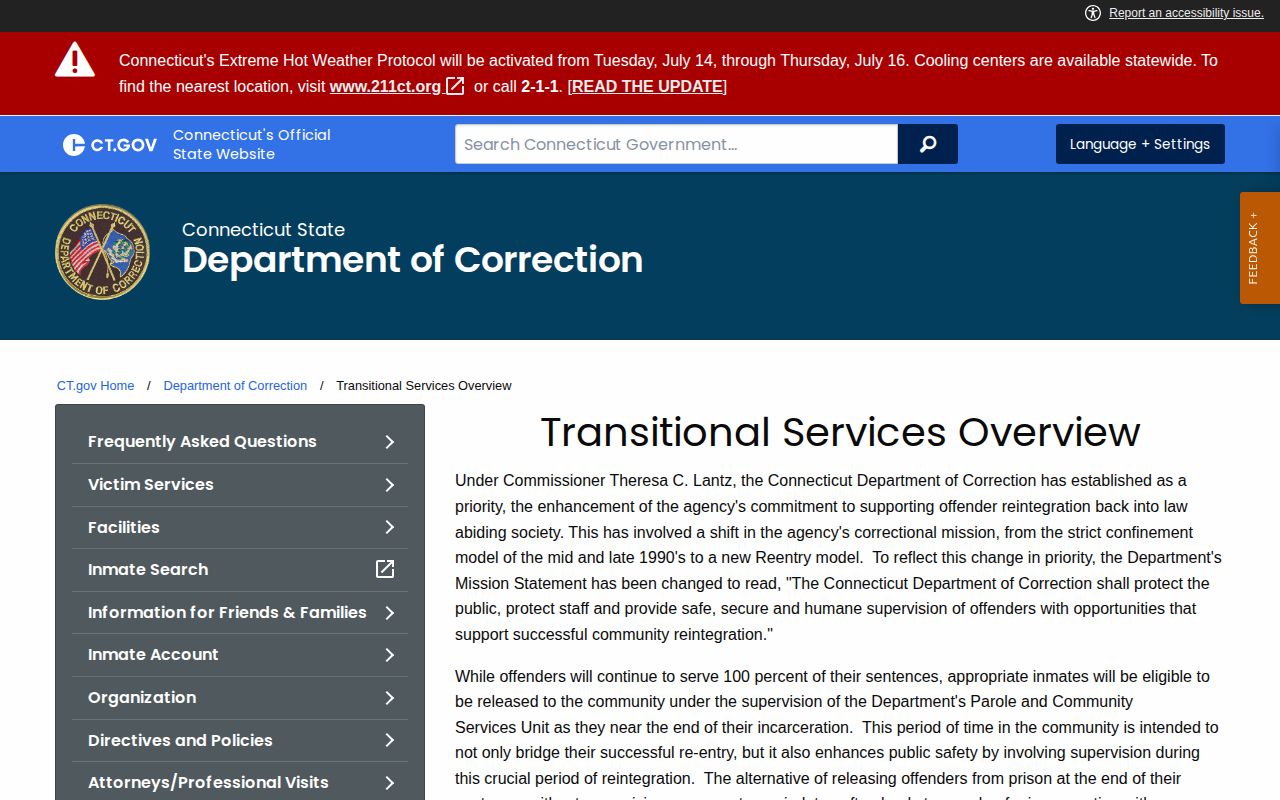
The state page explains why logistics may be arranged before Garner's public status changes.
Planning does not fix the date. Earned credit can be gained or removed for eligible sentences. A new charge, revised jail credit, court order, parole action, detainer, or facility transfer can also change the timeline. Recheck DOC and court sources close to the expected release.
Garner Institution Court Checks
Garner holds pretrial as well as sentenced people, so the court docket cannot be skipped. It can show bond, plea, sentence, presentence credit, probation, a violation, dismissal, nolle, or sentence modification. These entries may explain why DOC status changes.
One case may not reveal every hold. Compare the docket number, identity, and dates with DOC. Another state case, parole warrant, federal action, or immigration detainer may continue custody. If the case is erased or restricted under Connecticut law, respect that boundary and use only records the official custodian can lawfully provide.
Pretrial and sentenced records require different expectations. A pretrial person may have bond and court dates but no fixed sentence-completion date. A sentenced person may have estimated, maximum, and special parole dates calculated by DOC. The arrest date cannot be used to invent either result. Use the judgment and DOC fields that belong to the actual stage.
When the court permits release but Garner still appears as current location, account for the nightly data cycle and any other hold. Check the time of the order, then ask whether another commitment applies. A new institution means transfer. A community-supervision status may mean confinement ended while correctional oversight remains.