
Norwalk Parole and Probation
Connecticut assigns parole and probation to different parts of government. The Connecticut Board of Pardons and Paroles decides parole matters, while CT DOC remains responsible for people released from confinement until the sentence ends. Adult probation belongs to the Connecticut Judicial Branch Court Support Services Division. A court docket may therefore show probation even when no parole record exists.
Parole is conditional release from a prison sentence. Special parole is also a community status, but it is imposed as part of a sentence and follows incarceration. Probation is a court-ordered term that may begin after release, after time served, or without a state-prison commitment. None of these terms means the same thing as full discharge. Discharge means the applicable supervision term has ended.
| Point | Parole or special parole | Probation |
|---|---|---|
| Source | Prison sentence and BOPP/DOC process | Superior Court sentence or order |
| Primary record | DOC status, parole decision, supervision record | Court docket, judgment, probation record |
| Local route | BOPP and CT DOC | Norwalk Adult Probation and court clerk |
| Violation path | Rescission, remand, or revocation process | Violation of probation court case |
| End point | Sentence or parole discharge | Court-ordered probation discharge |
- Parole
- Conditional community release before the underlying prison sentence is complete.
- Probation
- Court supervision imposed as a sentence or as part of one.
- Remand
- A return to custody under an official order while a claimed violation is addressed.
- Discharge
- The formal end of a custody or supervision obligation.
Check Norwalk Release Supervision
There is no public Norwalk probation roster, and the reviewed BOPP sources do not provide a simple name-searchable parole-decisions database. Verification requires matching the person to the right official record. Begin with identifiers from the Norwalk police log, court docket, or CT DOC record. Name alone can produce a false match in statewide systems.
- Check the CT DOC Inmate Information Search for current location, status, estimated or maximum release dates, and special parole date.
- Open the official Connecticut criminal or motor-vehicle docket and look for a sentence, probation term, violation, modification, or final disposition.
- For parole, review the BOPP hearing schedule and parole information. A voted-to-parole date means “on or after,” not a guaranteed exit date.
- For probation, contact Norwalk Adult Probation with the docket number and ask which public procedural details can be confirmed.
- Use CT SAVIN for matched custody and court notifications, but register for those two event types separately.
- Request an official hearing copy or record from the agency that holds it when the online sources do not settle the question.
A person shown as released may still be supervised. Conversely, a hearing entry or future parole date does not show that release occurred. Confirm the actual transition through the DOC status, a CT SAVIN event, a court order, or an agency response. The broader Norwalk released inmate search explains how police, court, state, federal, and immigration custody paths differ.
Norwalk Probation Release Office
Judicial directory material lists the local adult probation office for Norwalk. This is the most direct local route for questions about court-ordered probation. It is not a public list of people under supervision, and staff can only disclose information allowed by law and court policy. Have the docket number, full name, court location, and disposition date ready.
Adult Probation, Norwalk
11 Commerce Street
Norwalk, CT 06850
Phone: 203-866-5025
Parole questions go to the statewide Board rather than the probation office. The Board posts hearings, parole guidance, revocation reports, and agency contacts. Written or recorded hearing material may require a Freedom of Information request.
Connecticut Board of Pardons and Paroles
55 West Main Street, Suite 520
Waterbury, CT 06702
Phone: 203-805-6605
Hearing-copy requests: BOPPFOI@ct.gov
The split matters. Sending a probation question to BOPP or a parole question to local probation can delay a clear answer.
Norwalk Parole Hearing Records
The BOPP hearings page posts public links for parole and pardon proceedings. Hearings can occur Monday through Friday and normally start at the posted time. A three-member panel takes part, and the panel announces its decision after open deliberation. Future events appear through the Board’s hearing and event calendar.
A decision can deny parole, set a later hearing, or vote to parole on or after a stated date. The Board may later modify or rescind a grant when new charges, disciplinary information, program discharge, or other new facts affect suitability. That is why the hearing outcome and the release status must be checked separately.
The Board expressly prohibits viewers from recording, photographing, screen capturing, or otherwise copying livestreamed hearing content. Use the public schedule to watch a hearing as allowed. Ask BOPP for an official copy instead of making one from the stream. No simple public name-search decisions tool was found in the reviewed official pages.
The successful manifest image below shows the official hearing information page, not a protected livestream. The Board’s hearing page should be checked for current links and notices.
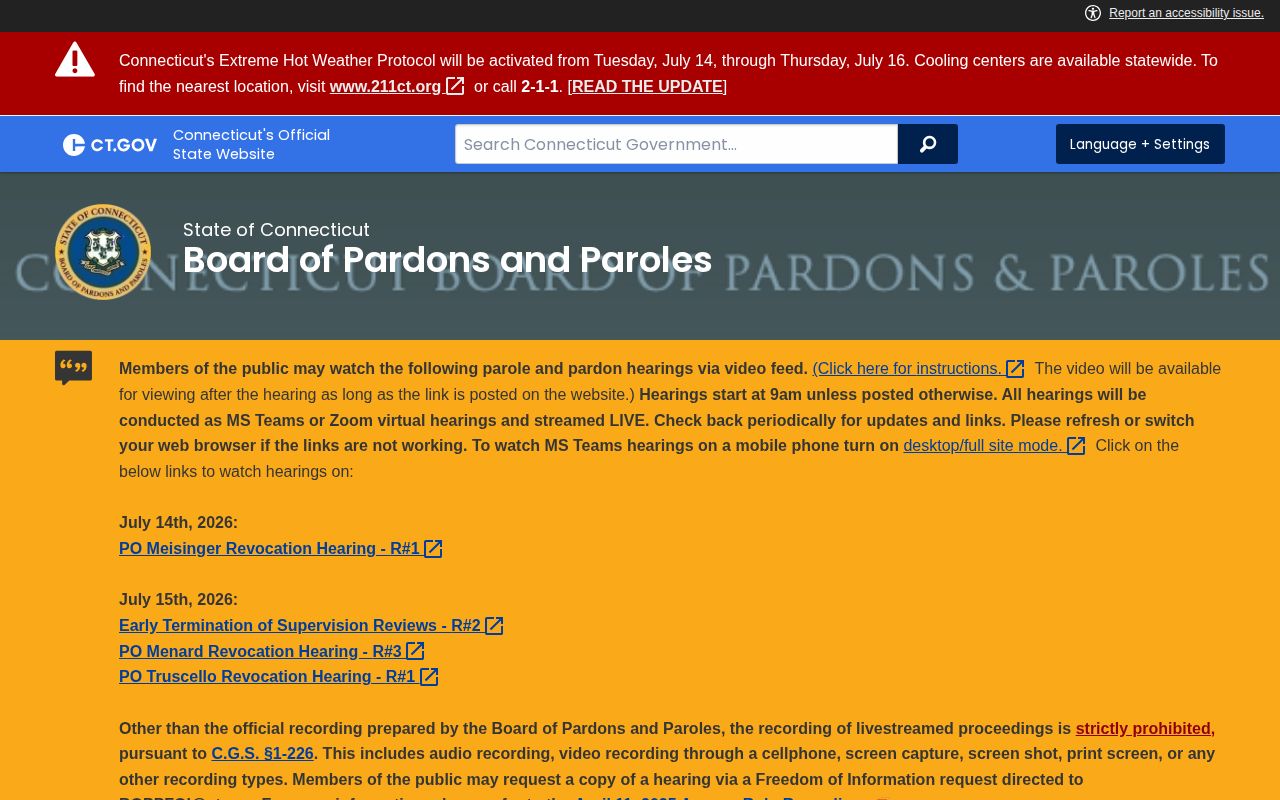
The page supports hearing verification while preserving the Board’s rule against capturing live proceedings.
Note: A posted hearing or voted-to-parole date does not prove that a Norwalk release took place on that date.
Norwalk Supervision Violations
Parole rescission happens before release when the Board reconsiders a grant. Revocation concerns a person already released to parole or special parole. The BOPP Revocation Unit schedules hearings and issues decisions in those matters. Its process may include a preliminary hearing and a later revocation hearing.
A claimed violation can lead to remand into CT DOC custody, but an allegation is not the same as a final decision. The result may include reinstatement or return to custody. If the person reappears in the inmate search, compare the new DOC status with the revocation record rather than assuming a new criminal sentence.
Probation violations take a court path. The Judicial Branch docket can show a violation case, hearing, sentence change, or disposition. An absconder is someone alleged to have stopped reporting or left supervision without permission. That status may be tied to a warrant, but only an official court, DOC, or supervision source can confirm it.
CT SAVIN can help track a matched custody change when a supervised person returns to DOC, yet it does not replace the revocation decision or court file. Registering for a court case does not automatically create a custody alert. Searchers should keep the inmate number and docket number apart, then follow both records until the agency action is clear. If a new arrest occurred in Norwalk, the Daily Logs may point to a new case, but the log alone cannot establish whether parole or probation was revoked.
Norwalk Release Reentry Planning
CT DOC’s Transitional Services Overview says discharge planning begins at least 45 days before release. Staff address clothing, transportation, identification, treatment, and aftercare. The process applies throughout DOC facilities, including correctional centers that receive people from Norwalk courts.
This planning can begin while the public inmate search still shows custody. It does not establish the final release date and does not prove supervision has begun. It does explain why a sponsor, treatment provider, or field officer may be involved before the record changes. BOPP also says field staff contact the person and sponsor near a parole date to arrange pickup or transportation.
For a Norwalk case, Bridgeport Correctional Center may be the starting facility for a male court commitment. York Correctional Institution serves female pretrial and sentenced people statewide, while Garner may receive a transfer based on DOC needs. Release planning follows the state placement, not a nonexistent county jail system.
Transportation planning also helps explain a timing gap. BOPP describes a voted-to-parole date as an on-or-after date because pickup, an approved sponsor, placement, and other arrangements may still need coordination. The public DOC record can therefore retain a custody status while field staff work toward release. A sponsor should rely on direct instructions from Parole and Community Services, not arrive at a facility based only on a hearing date. Once the person leaves, the supervision record and DOC status show that the next phase began.
Correct Norwalk Release Records
The Norwalk Police Records Unit updates internal arrest records when court dispositions arrive, including guilty, nolle, and dismissed results. A nolle means the prosecutor declined to pursue the charge at that stage. If the local police record is missing a later outcome, first obtain the official court disposition and match it to the police case number.
Send the Records Unit clear identifiers and describe the item that appears wrong. The official Records Unit page lists its public window and contact details. That office can address the police record it holds, but it cannot rewrite a DOC status, BOPP decision, or Judicial Branch docket. Each agency remains responsible for its own record.
Supervision ends only through the relevant official discharge or sentence completion. A police-log change may clarify a local case disposition, yet it is not a parole or probation discharge. Keep copies of the court order, agency response, and the identifiers used to match them.
Note: Start a correction with the agency that created the disputed Norwalk release or supervision entry, supported by the final court record.