
Norwalk Police Release Paths
Norwalk Police Department can arrest, book, and hold a person for a short period. It is not the city version of a county jail. A local release may follow a written promise to appear, a bond, or a court order. Police may also transfer a person to the Connecticut Department of Correction. Leaving One Monroe Street does not always mean release into the community. A transfer ends police custody while another custodian begins to hold the person.
The record trail follows that choice. Police arrest and custody paperwork matter when release occurred before DOC intake. A court docket may show bond, a promise to appear, a later disposition, or a sentence. When DOC took custody, the statewide inmate search, CT SAVIN notification service, and the receiving correctional center become the better sources. Bridgeport Correctional Center is especially relevant because CT DOC expressly identifies it as serving Norwalk Superior Court.
| Path from police custody | Best confirming source |
|---|---|
| Promise to appear or local bond | Norwalk police paperwork and the court docket |
| Court-ordered release | GA 20 clerk or official case lookup |
| Transfer to CT DOC | CT DOC inmate search and CT SAVIN |
| Release to probation | Court disposition and Adult Probation |
Note: A person who left the police lockup may still be held by CT DOC or another lawful custodian.
Norwalk Police Arrest Log
The official Norwalk Police Daily Logs page publishes arrest, citation, and incident logs. Norwalk says those logs are generated automatically each morning. They identify police events, not releases. A log can supply the arrest date, case number, charge, court date, and other identifiers needed for the next search, but it should never be read as proof that a person is still held or has been released.
The city page is useful because Norwalk does not publish a current jail roster, a released-inmate list, or a sheriff booking grid. Its place in the search is narrow and important: confirm the local police event, copy the case details, and move to the correct release source. The image below shows the official city page rather than an invented custody feed.
View the official Norwalk Daily Logs source.
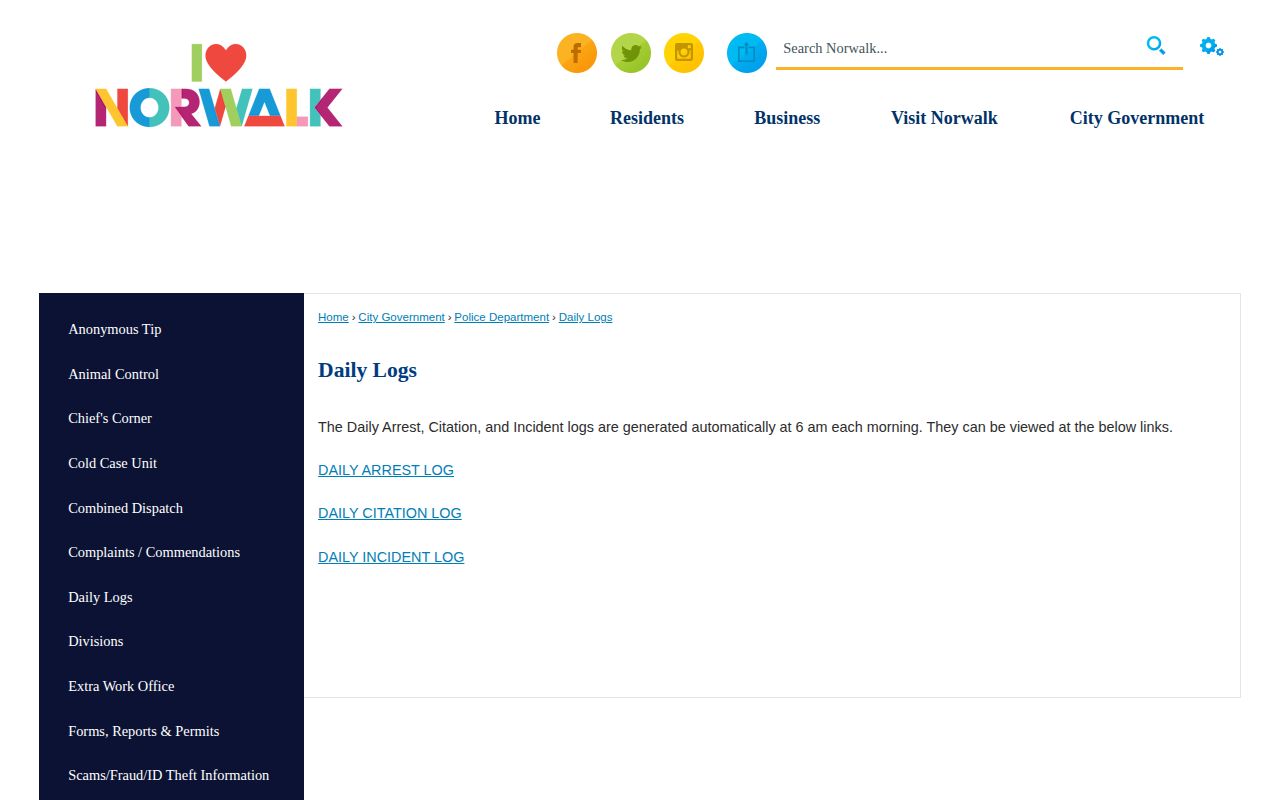
This official page leads to the local PDFs used to identify a Norwalk case before release verification continues elsewhere.
Confirm Norwalk Police Release
Start with the type of custody. A person released by Norwalk Police without entering DOC may never appear in the CT DOC public search. That absence is not a contradiction. It means the useful evidence may remain with the police and court. Conversely, anyone committed to a state correctional center should be checked in the statewide system even if the arrest began in Norwalk.
- Open the Daily Logs and identify the correct arrest event.
- Record the full name, event date, case number, charge, and court date.
- Check the official Connecticut Judicial Branch criminal or motor-vehicle case lookup for bond and disposition entries.
- If state custody began, search the CT DOC Inmate Information Search by inmate number or name and date of birth.
- Use Connecticut VINE for matched custody or court alerts.
- Ask the Norwalk Police Records Unit for the disclosable custody-release record when no online source resolves the question.
The broader Norwalk released-inmate search and records path explains how these systems fit together when the original custodian is uncertain.
Norwalk Police Release Records
The Norwalk Police Records Unit handles public-window service, case-report copies, subpoenas, and Freedom of Information requests. It also updates internal arrest records when court dispositions arrive, including guilty, nolle, and dismissed outcomes. A nolle means the prosecutor declined to proceed with the charge at that stage. This later update is why the police record may tell more than the first daily log.
Make the request precise. Include the person's full name, date of birth if known, arrest date, police case number, charge, and court date. Name the record sought, such as an arrest report, booking or intake record, bond or promise-to-appear paperwork, transfer record, property-release form, or custody-release record. A booking photograph may be requested if maintained and disclosable, but Connecticut law does not guarantee that every arrest photo must be released.
Administrative Services
One Monroe Street
Norwalk, CT 06851-5125
203-854-3009 or 203-854-3151
npdrecordsunit@norwalkct.gov
Public service hours: Monday through Friday, 8:00 a.m. to 4:30 p.m.
Holiday and temporary closures can change public-window access. Check the live Records Unit page before traveling. Connecticut FOIA permits copy fees and agency-specific costs, so ask for an estimate if a request is broad.
Norwalk Police Court Records
Court records often outlast the lockup stay. A criminal or motor-vehicle docket can show bond changes, a promise to appear, arraignment, plea, sentence, probation, dismissal, nolle, or a later sentence modification. Those entries explain why the person left police custody even when no page uses the exact phrase “released inmate.” GA 20 at Norwalk is the key local court source for many city cases.
A docket does not prove that no other hold exists. Another case, detainer, federal warrant, immigration transfer, or DOC commitment may change the result. A detainer is a request from another authority to hold or transfer a person. Match the court result against the police record and, where relevant, the DOC search. If the case is erased or restricted under Connecticut law, the public lookup or clerk may not disclose it.
- Disposition
- The court's outcome for a charge or case.
- Nolle
- A prosecutor's decision not to continue a charge at that time.
- Detainer
- A hold or transfer request from another authority.
- Discharge
- The end of custody or supervision, depending on the record.
Norwalk Police DOC Transfers
If Norwalk Police transferred the person to CT DOC, the police release record proves only the end of local custody. CT DOC's Offender Based Information System tracks people from intake to eventual release, and a nightly feed populates the public search. Results may show current location, status, bond amount, controlling offense, sentence date, maximum release date, estimated release date, special parole date, and detainer information.
Bridgeport Correctional Center holds both pretrial and sentenced men and serves Norwalk Superior Court. York Correctional Institution is Connecticut's institution for female offenders and serves all state Superior Courts. Garner Correctional Institution may appear after a department-wide transfer, including assignments tied to mental health treatment. A non-Norwalk facility name can therefore be the correct result for a Norwalk arrest.
DOC data is not real-time. A same-day release can take time to reach the public search. CT SAVIN may issue a matched event notice, but it is an alert service rather than a certified record. Call the official facility or records channel when a prompt confirmation is essential.
Correct Norwalk Release Records
A police record can lag behind the court. The Records Unit says it updates arrest records when it receives dispositions. If a record still shows an old or incomplete result, obtain the official court disposition first. Then send the case identifiers and disposition to the Records Unit and ask what correction process applies. The source office controls its own record and any lawful correction.
Connecticut erasure law can also explain why an old case disappears. Qualifying records may be erased after an acquittal, dismissal, certain nolles, a pardon, or an eligible conviction under the governing statutes. Do not try to work around an erased record. If the police, court, and DOC sources differ, compare dates and custody types before concluding one is wrong.
Timing can also account for a mismatch. Norwalk's logs use a daily cadence, while CT DOC sends a nightly feed to its public search. Court entries follow the court's own filing process. A release or transfer may reach one system before the others. Record the time each source was checked, then return to the office that owns the disputed event. For local release, that may be the police Records Unit or court clerk. For state release, it is CT DOC. For parole, it is DOC and BOPP.
A correction should preserve the line between arrest, release, and disposition. An arrest can remain accurately recorded after release. A release can be correct while the charge remains pending. A later dismissal or nolle changes the case result, not the fact that custody once occurred. Asking the right office to correct the right field avoids treating separate events as one error.
Note: Police release, state discharge, and the end of court supervision are separate events that may occur on different dates.